

As someone who loves pulling joy and inspiration from beautiful things, I often find myself spiraling (and sometimes “wiki-spiraling,” which we can contribute much of my random knowledge to) down paths of intense research.
In the last year, one such occasion has been early 20th-century style. Perhaps it’s my ongoing consumption with all things Agatha Christie (both the Poirot novels and the Poirot show have been on constant and consistent repeat). Perhaps it’s the slowing down of clothing consumption that has me looking back in time for pieces that might withstand the test of time. Perhaps it’s wanting to get more and better use out of my clothing and looking for ways to integrate new looks through styling.
Whatever the case may be, I’ve found myself with particular fondness for a variety of stylistic periods — really, I have style inspirations from nearly every decade and tend to cycle through them rapidly. Still, there will always be looks and cuts and periods of time that I come back to time and time again, one of those being:
1940’s Fashion
While the 30s are an often overlooked decade as far as style goes, the 40s tend to be wildly celebrated by those who are “into” vintage.

American and European involvement in wartime efforts meant that fashion more or less stalled at the beginning of the decade. Fabric was rationed and women were encouraged to go without. Tailoring and recycling were at an all-time high, with instructional manuals on how to update your old clothing to cater to the new, styles (including shortened hems to accommodate for fabric shortages) that developed. Military inspired clothing and utility garments, including purses to carry your gas mask in, were commonplace.
But as time passed and victory was won, the post-war world of fashion returned to revolutionizing again, and flourished under the victorious mentality. Here is where iconic styles like the 1940 Dior “New Look” came to be.
I am admittedly not a historical fashion purist, and when I say 1940’s, I can, might, and do mean late 30’s to early 50’s and tend to overlook inaccuracies in hem lengths and trend cycles. In practice, I find that 1940s to be particularly inspiring as far as winter goes; wool, fur, and hats seem to be where my heart lies, and it’s no surprise that during my favorite season, I find myself inspired by one of my favorite decades.
Overall, the decade’s style has been inspirational in a variety of ways; the latter half of the 20th century had a surge of “80s does 40s” garments including dresses with sharp shoulders, an increase in menswear inspired suiting like pleated trousers and gathered wool skirts. This was also a time when silk stockings, hats, very large hats (so many hats!) brooches, and train cases were all commonplace items.
Anyways, I find myself drawn to the sometimes understated, sometimes flamboyant, styles of the 40s. Paired down and utilitarian at one end, fabulous in furs and drenched in jewels at the other.


Ingrid Bergman in Casablanca (1942), Lauren Bacall, Ava Gardner in 1942, and Gene Tierney in Leave Her to Heaven (1945)
In August of 2024, I read Forties Fashion: From Siren Suits to the New Look by Johnathan Walford and had this to say in my review:
Really interesting breakdown of fashion trends in the forties, more text but a sufficient amount of visual examples as well. Seemed to be well researched as fashion was so influenced by pre, mid, and post-war international affairs.
Notes on how to take inspiration without consumption:
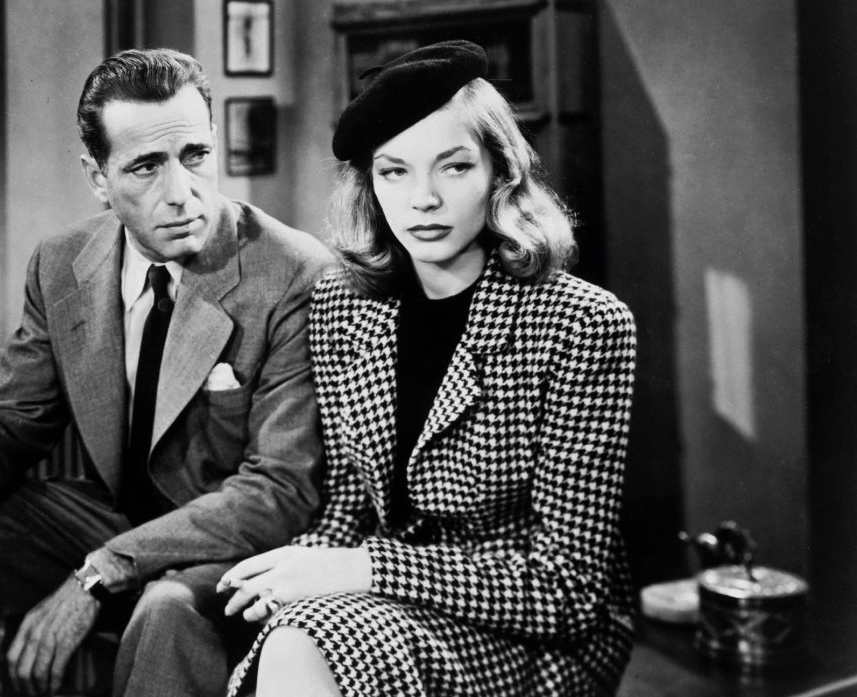
Suiting, whether a set or separates, is a natural sequiter for winter. I don’t personally own a mink coat but I certainly own pleated trousers and button ups that could be easily styled with some other touches that give a 40s flare, accessories being an easy one.
A regular beret could be embellished with a brooch a la Gene Tierney or embellished with a feather as shown in the illustrations at the beginning of this post. Hats were worn on a tilt, seen on Ingrid Bergman in Casablanca (1942) and Lauren Bacall with her checked suit in To Have and Have Not (1944). Brooches and neck scarves were also common, both of which are either found easily in one’s closet or with a quick trip to a thrift store.
Beauty also goes a long way when it comes to taking vintage inspiration; there countless roller patterns that can be emulated with a modern curling iron and set of bobby pins. I found this post from vintagehairstyling.com to be particularly good at breaking down vintage hairstyles, in this case from the 1946 movie The Big Sleep, which features dear Lauren and her set pattern.
Recommended further reading: Wartime Wardrobes: What 1940s fashion rationing can teach us about style and society
Featured image from genibee on Flickr


